What is the detective gameplay loop?
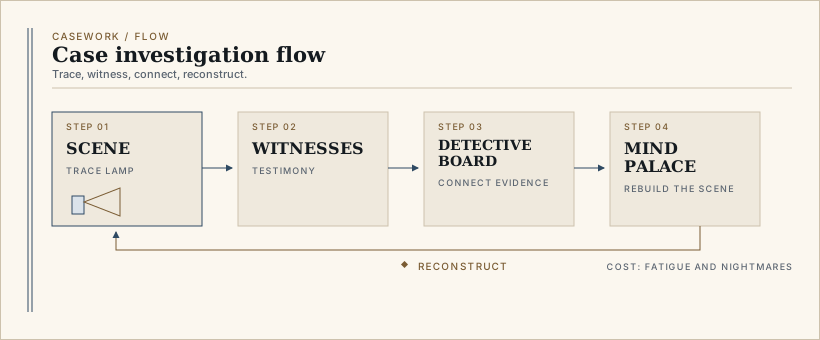
Four steps, in order. Go to the scene and find physical evidence, question the people connected to the case, return to the agency and pin the clues to the Detective Board, then reconstruct the scene in the Mind Palace and draw the conclusion. Stealth sections, safe-cracking and dream parkour are interspersed within that loop rather than separate modes.
The order matters because each step feeds the next: the Board only holds what you found and were told, and the Mind Palace only reconstructs what the Board contains. Skipping the interviews produces a thin reconstruction, which is how a case can stall without the game ever blocking you.
How does the trace lamp find evidence?
The trace lamp is the scene-search tool. It reveals residue and marks left at a location that are not visible in normal light, which is the first pass of any investigation. You sweep a scene with it before you start asking questions, because the physical evidence is what gives the interviews their direction.
Scene work is not only reading marks. Cases also include stealth segments, safe-cracking and dream parkour, so a single case can move between quiet observation and an action sequence without leaving the investigation frame. Treat the lamp as the tool that opens a scene, not as a puzzle solver.
How do stealth, safe-cracking and dream parkour fit a case?
They are pace changes inside the investigation rather than separate modes. A case can ask you to move quietly past a guard, open a safe, then run a dream sequence, and every one of those segments still feeds the same Board. What changes is the verb, not the frame.
It helps to separate what the CBT2 build actually contained from what was only promised, because the two were listed side by side in test coverage.
| System | CBT2 status | Practical note |
|---|---|---|
| Stealth segments | Present | Pace change inside a case, not a separate mode |
| Safe-cracking | Present | A scene-work variant |
| Dream parkour | Present | Traversal segment inside the investigation frame |
| Rewind to a key node | Present | Undo a deduction without restarting the case |
| Multiple endings | Present in side content | Resurrected Corpse: 8 stages, 3 endings |
| Dialogue history | Planned, per the official feedback list | Not confirmed for launch |
None of them replaces a step in the loop. The case still closes through the Board and the Mind Palace, so if you are stuck, the extra modes are not where the missing clue is.
What does Observe do?
Observe reads people and places rather than objects. It highlights NPC behaviour, lets you pick out a disguised enemy, and connects clues that belong together. The prologue teaches it alongside movement, jumping and grappling, which tells you how central it is: it is a traversal-era verb, not a late-game unlock.
In practice, Observe is the tool that converts a crowd into suspects. If a scene looks empty of leads, the answer is usually that you have not switched from looking at objects to watching behaviour. The beginner's guide covers where this sits in the opening hour.
How does the Detective Board work?
The Board lives at the agency, S.T.A.T.S. on Morgue Street, and it is where clues become a case. Evidence and testimony are pinned there and arranged, and the arrangement is what the Mind Palace then reconstructs. The agency is also the base for the associate system, so the Board is not a menu you visit once.
Do not treat the Board as a checklist that fills itself. Its value is in the ordering: which clue supports which claim, and which piece of testimony contradicts another. That is the part of the investigation the game expects you to do rather than to watch.
What is the Mind Palace and what does it cost?
The Mind Palace is the protagonist's reconstruction ability. Using the evidence on the Board, the detective rebuilds the crime scene in his or her head and walks through the case as a physical space. It is the step where the reasoning becomes visible, and it is the most distinctive system in the game.
It is also costly. The ability is extremely draining and triggers vivid nightmares, and Firtho's medicine is what relieves the after-effects. That cost is narrative as much as mechanical: the game treats the reconstruction as something the detective pays for, not a free hint button.
Do cases have multiple endings and can you rewind?
Yes to both, at least in the side content. The Case of the Resurrected Corpse, Firtho's character case, runs eight stages and has three endings, with testimony that sounds reasonable until you compare it and evidence that is deliberately misleading. Which evidence you accept changes the direction of the deduction.
The game also supports rewinding to a key node to redo a deduction, so a wrong conclusion is not a dead end. The official feedback list includes a planned dialogue-history feature for reviewing what was said, which is the other half of the same quality-of-life package. The case structure page collects the main-story cases, and the progression page covers the agency systems around the Board.
Is the reasoning fair to the player?
Yes, by design. The stated principle is fair-play deduction: every clue the conclusion depends on is shown to the player. The game does not hide a fact and then ask you to guess it, and the red herrings are planted as things you can inspect and reject rather than as invisible traps.
That does not make the cases easy. Fair-play design means the difficulty sits in comparison and ordering, not in withholding. If you are stuck, the useful move is to re-read the Board and re-check which testimony survives a cross-reference, not to look for a missing item in the room.
Common questions
Do I have to use the Mind Palace?
It is the reconstruction step of the main case loop, so yes for story cases. It is not a free action: the game frames it as draining and nightmare-inducing.
What does Firtho's medicine do?
It relieves the after-effects of Mind Palace use. Firtho is the doctor among the playable roster.
Can I undo a wrong deduction?
Yes. Cases support rewinding to a key node, so you can redo the reasoning from that point rather than restart the case.
Are clues ever hidden from the player?
No. The design principle is fair play: every clue the answer relies on is presented, and misleading evidence is inspectable.