What is Affinity and what is its cap?
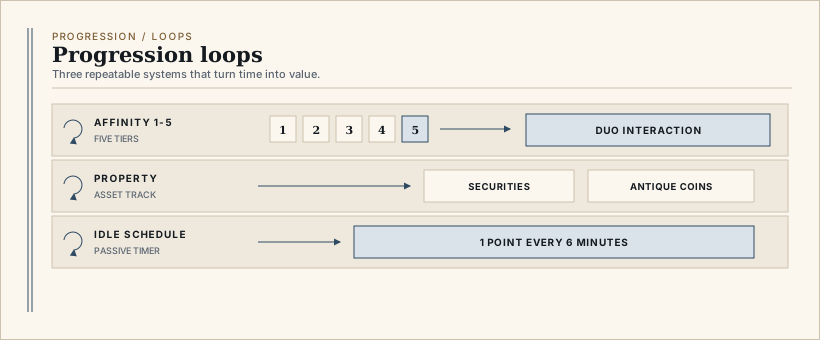
Affinity is the relationship level for each character, and it caps at level 5 in CBT2. Raising it unlocks special interactions, including two-person scenes. Six characters were confirmed to have those duo interactions: Alf, Bentham, Firtho, Red Rose, Rex and Cynthia II. Not every character had one implemented at the time.
The interactions are the point of the system rather than a stat bonus. They are short, character-specific scenes that only become available when the relationship is high enough, which is why Affinity progress is worth tracking separately from combat investment.
What is Rapport and what unlocks at level 3?
Rapport is a second relationship track fed by gifts. Reaching level 3 unlocks a Private Meeting, which functions like a personal character quest. In CBT2 only Alf's Private Meeting was implemented; the other characters' scenes were not yet in the build. The English name for the track is not official, so treat Rapport as a working label.
Whether Affinity and Rapport are two views of one system or two parallel systems is not resolved. The sources describe Affinity as a five-level bond and Rapport as a three-level gate, and both readings appear in test coverage. Plan as if they are separate until the launch build makes it clear.
What are the three currencies?
Coins, Securities and Antique Coins. Coins are the ordinary currency. Securities are the investment currency tied to property and are also earned from the café and card games. Antique Coins are the life-minigame currency and are produced by shops alongside Securities.
| Currency | Role | Main sources in CBT2 |
|---|---|---|
| Coins | General spending | Standard play |
| Securities | Property and investment | Shops, café, card games |
| Antique Coins | Life minigames | Shops, minigame play |
How does property investment work?
You invest in shops, and the shops produce Securities and Antique Coins over time. It is a passive income loop rather than a shop management game: the decision is which properties to hold, not how to run a counter. The agency on Morgue Street is the base for this side of play.
No output rates are published, so this page does not estimate payback or rank properties. Treat it as a background trickle you check between cases, not a build-defining engine that decides your roster. The mechanic is the useful part: property is where Securities come from, and Securities are what the investment side of the economy runs on.
What are the life minigames?
There are three: a card game, a café, and horse racing. All three settle in Antique Coins, and all three are optional daily activities rather than progression gates. They are the light-content layer that balances the case work.
| Minigame | What it is | Pays in |
|---|---|---|
| Cards | A table card game | Antique Coins |
| Café | A café management activity | Antique Coins |
| Horse racing | A race-day activity | Antique Coins |
How does stamina work?
There are two pools. One is the usual stamina for activities; the other is a life-stamina pool tied to the daily systems. Both refilled at the same rate in CBT2: one point every 6 minutes. The second pool is called the Idle Schedule in the source material, although that English name is not official.
Because the pools are separate, spending combat stamina does not stop you from playing cards or visiting the café. That separation is the main practical fact about the system, and it is why the daily layer can be played around a combat session rather than after it.
Where does Deep Cognito fit?
Deep Cognito is the combat challenge track that sits above the daily loops. It is where the hard fights live, and it is also one of the sources of Reactor Crystal. It is covered in full on the endgame page.
For the currency side, the gacha page explains how Philosopher's Stone and Reactor Crystal differ from the three currencies above. They are not part of the property economy and should not be treated as interchangeable with Securities or Antique Coins.
What should a daily run look like?
| Action | Resource | Refill or cap | Why it matters |
|---|---|---|---|
| Spend combat stamina | Combat stamina | 1 point / 6 min | A capped pool stops producing |
| Spend life stamina | Life stamina (Idle Schedule) | 1 point / 6 min | Separate pool, so it does not compete with combat |
| Play cards, café or racing | Antique Coins | Daily, optional | Funds the life-minigame layer |
| Check property | Securities, Antique Coins | Passive | Background income |
| Give gifts | Rapport | Gate at level 3 | Unlocks a Private Meeting |
| Raise Affinity | Affinity | Cap 5 | Unlocks duo scenes |
The checklist is ordered by what cannot be recovered. Stamina and Affinity stop accruing when capped; property income and minigames can be played later. Spend both stamina pools first, then decide whether the day has room for cards, café or racing.
Property output rates are not published, so there is no honest way to rank payback. Treat it as a trickle you check between cases, not a build-defining engine.
Common questions
Is Affinity the same as Rapport?
Unclear. Affinity is described as a five-level bond and Rapport as a three-level gate for Private Meetings. They may be parallel tracks.
Which Private Meeting can I play?
Only Alf's was implemented in CBT2. The others were listed but not available in the test build.
Do both stamina pools refill at 6 minutes?
Yes in CBT2. The combat pool and the life pool shared the same one-point-per-6-minutes rate.
Can property pay premium currency?
No evidence of that. Property produced Securities and Antique Coins, not Philosopher's Stone or Reactor Crystal.