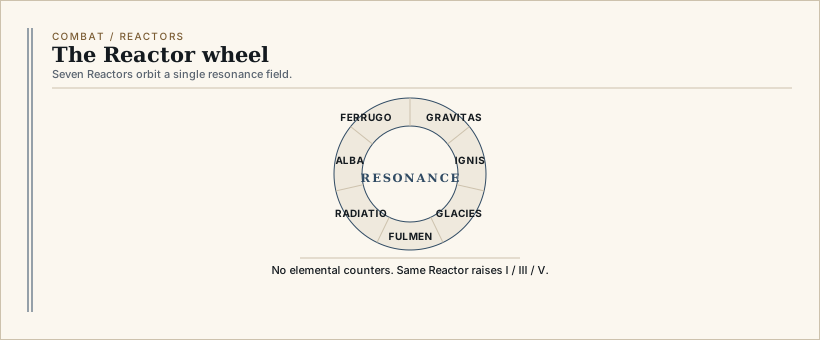
Does Silver Palace have elemental counters?
No. There are seven Reactors, but they do not counter one another and there are no reaction chains such as fire melting ice or lightning electrifying water. The official mechanic is Resonance, and the Reactor list describes what Silverium becomes in each state rather than what beats what.
This is the single most common misinformation about the game. Guides that rank Reactors on a counter chart are describing a system Silver Palace does not have, and team advice built on that chart will be wrong even when the individual character ratings are right.
What are the two sides of Resonance?
Resonance is documented two ways, and both are true at the same time. One reading is team composition: the game reads the Reactors across your four characters and grants a party-wide bonus. The other reading is charge: every hit fills a Reactor gauge, and a full gauge triggers that Reactor's effect on the target.
| Side | What triggers it | What you get |
|---|---|---|
| Team composition | The Reactor mix across your four characters | Resonance level bonus, or Phase Transition |
| Charge | Hits landing on an enemy | The attacker's Reactor effect when the gauge fills |
They are complementary rather than contradictory: composition decides which bonuses your party is eligible for, and charge decides when those effects actually fire in a fight. A team can be built correctly and still underperform if nobody is landing enough hits to fill the gauge.
What do Resonance levels I, III and V mean?
They mark how much of your team shares one Reactor. One character of a Reactor gives level I, two give III, and three give V — the numbering skips the even steps because the bonus tiers are built around those three counts. The more concentrated the party, the higher the tier.
The trade-off is flexibility. A three-of-one-Reactor party gets the strongest same-Reactor bonus but leaves only one slot for everything else, while a two-two split gets a lower tier on both sides. There is no universal answer, because the exact bonus values have not been published; the team building page covers the composition question separately from the numbers.
What triggers Phase Transition?
Three different Reactors in the party. That is the "rainbow team" condition, and it is an alternative to stacking rather than a stronger version of it. You give up the high same-Reactor tier and gain the Phase Transition state instead.
Because the party is four characters, a Phase Transition setup still has one spare slot, which usually goes to a duplicate or to the role your team lacks. The condition is about the number of distinct Reactors, not about which three you pick, so any three different ones qualify.
How does the charge side of Resonance work?
Every hit charges the gauge belonging to the attacker's Reactor. If more of your characters share that Reactor, the gauge fills faster, which is why a concentrated team feels different from a mixed one even before the composition bonus is counted. When the gauge fills, that Reactor's effect triggers — for example, Ignis bursts on the target and Glacies applies damage over time.
Enemies carry the same logic from the other direction: they accumulate Resonance values per attacking Reactor, and multiple Reactor values can sit on one target at once. That is an alternate description of the same charge mechanic, not a separate system, and it means a mixed party can keep several Reactor effects running on the same enemy.
What are the seven Reactors?
The official list defines each Reactor by the phase Silverium takes in it. Ferrugo is the exception to watch: it has no playable character in CBT2, so any team advice that assumes a Ferrugo unit is theoretical.
| Reactor | Official phase description | CBT2 characters |
|---|---|---|
| Gravitas | Concentrated dark matter halo | The Detective |
| Ignis | Super heated combustible gel | Alf, Cinderella, Red Rose |
| Glacies | Ultra cold condensate | Argos, Gratia, Bentham |
| Fulmen | Highly conductive magnetofluid | Lorin, Rex, Grimm |
| Radiatio | Unstable radioactive material | Firtho, Captain Kaboom |
| Alba | Stable pure-phase matter | Cynthia II, Gucia |
| Ferrugo | Activated Silverium | None playable in CBT2 |
What are Amplitude Coefficient and Multiplier?
They are the two stats that scale Resonance output: Amplitude Coefficient is the Resonance crit rate, and Multiplier is the Resonance crit damage. Together they decide how hard a triggered Reactor effect hits, which is why a character's own damage percentages are only part of the story.
Neither stat is explained numerically in public material. The practical takeaway is that Resonance is a build target in its own right: investing in a character who triggers Reactor effects often means caring about these two values as much as about raw attack.
How many Resonance effects are there?
Eight were observed in CBT1: seven that raise a specific Reactor's damage and one that raises final damage or relates to Phase Transition. The exact bonus table has not been published, by either the official channels or the English data sites, so no reliable per-level numbers exist.
What that means for planning is simple: build for the structure — same-Reactor concentration or three-Reactor Phase Transition — and treat any specific percentage you see as CBT2-era community testing until the game publishes a table. The Catalyst system is the other layer that interacts with this, and the combat guide covers the swap that carries the effects into a fight.
How should you align a party?
Three alignments are worth building on purpose rather than by accident:
- Mono-school spike (Ignis). Maximum Resonance alignment, at the cost of Phase Transition access and flexibility. Ignis, Glacies and Fulmen are the deep pools; Gravitas has only one character, so a Gravitas alignment is structurally impossible.
- Shred-matched pair. Grimm with Rex for Fulmen, or Gucia with Cynthia II for Alba. This is the most provable synergy, because the shred values are published even though the Resonance table is not.
- Three-school Phase Transition. Deliberately trigger Phase Transition, then accept weaker Resonance alignment. Its payoff is easy to undervalue early because it is invisible on a damage dummy.
Bentham is the one CBT2 kit labelled Resonance DPS: a 4★ Glacies Outlaw whose Contractual Circle converts a placed zone into Funds income. If the party is scattered across schools, he has nothing to scale off. The test of a Reactor plan is whether it has a character who cashes it out.
The per-school bonus table is still unpublished, so treat alignment as a structural decision, not a percentage you can calculate. Anchor on the published shred values — Grimm's 15% and Gucia's 10% — when you need a number you can verify.
Common questions
Is there an elemental weakness system?
No. No Reactor is strong or weak against another, and no enemy carries a Reactor weakness chart.
Should I always stack the same Reactor?
Not necessarily. Stacking raises Resonance to III or V, but three different Reactors unlock Phase Transition instead. Which is better depends on the bonuses, which are unpublished.
Can I build a Ferrugo team?
Not in CBT2. Ferrugo has no playable character, so it exists as a Reactor on the list without a unit to field.
Where do Resonance numbers come from?
Community testing, mostly from CBT1 and CBT2. The official bonus table has not been published, so treat any figure as provisional.