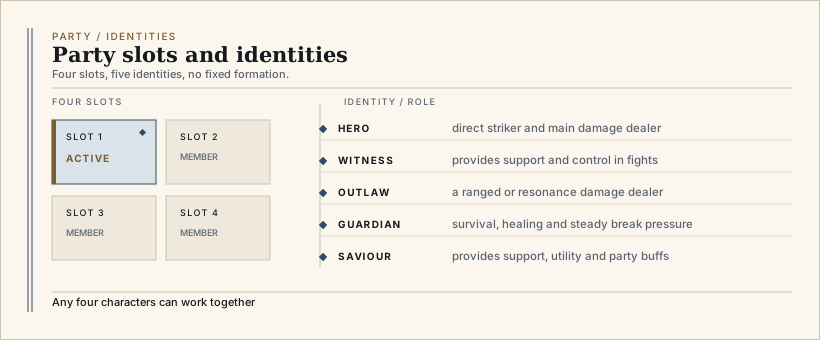
How many characters are in a party?
Four, with one character on the field at a time. The other three are off-field, waiting for a swap and contributing to the shared Reactor gauge. This is the structure the official material consistently describes, and it replaced the three-character assumption from early English coverage.
One active character means your swap timing is the real team-building decision. A fourth slot is not a benchwarmer; it is a kit you can bring out at a specific moment, which is why "who do I swap into" matters more than "who has the highest number".
What are the five Identities?
Hero, Witness, Outlaw, Guardian and Saviour. Each character carries one, and it describes the general shape of the kit rather than a hard role requirement.
| Identity | What it tends to do | CBT2 examples |
|---|---|---|
| Hero | Direct striker, main on-field damage | The Detective, Alf, Rex |
| Witness | Support and control | Argos, Cynthia II, Grimm |
| Outlaw | Ranged or resonance-focused damage | Cinderella, Bentham |
| Guardian | Survival, healing and break pressure | Lorin, Firtho, Gratia |
| Saviour | Support and utility | Red Rose, Captain Kaboom, Gucia |
The labels overlap in practice. A Guardian can be a break unit, a Saviour can carry the party's buffs, and a Witness can be the character you leave on field longest. Read the label as a starting point, then check the actual kit.
What does the "Ad" suffix in the client mean?
Nothing important. The international client sometimes shows an Identity with an "Ad" suffix attached, and it is a display artifact rather than a sixth Identity or a sub-role. Ignore it when you read a character screen or a wiki table.
Five Identities are the actual design space. If you see a list with six or seven because of suffix variants, the extra entries are duplicates rather than missing categories.
Who owns the Tactical Assault?
The incoming character. A swap made with a full Reactor gauge segment fires the Tactical Assault of the character who enters, not a combination effect with the character who leaves. That ownership rule is why any four characters can be fielded together.
It also means team building is about coverage: four kits you are happy to swap between, each with a swap attack worth using. There is no pairing table to consult, and no "these two must be together" rule. The Catalyst layer attaches to the same moment, so the incoming character's loadout is what actually resolves.
Should you build around elemental reactions?
No. There are no elemental counters and no reaction chains in Silver Palace. The seven Reactors define Resonance bonuses, and the party-wide effect comes from how many characters share a Reactor or from running three different ones for Phase Transition.
So the matching question is real but different: it is about Resonance tiers, not about countering an enemy. A mono-Reactor party reaches Resonance V, a three-Reactor party gets Phase Transition, and both are legitimate. The Resonance guide lays out the tiers and the charge side.
What is a reliable first team?
One direct-damage character, one break character, one support or healer, and one flexible slot. That covers the two things that actually decide fights — output and Stun Buildup — and leaves room to add whatever your account is short of.
The flex slot is where team building gets interesting: a second break character for elite-heavy content, a shielder for bosses with long patterns, or a second damage kit for short fights. Do not fill it with a duplicate role by habit; fill it with the answer to the content in front of you.
Which CBT2 characters fit each job?
The Detective is the direct-damage anchor: a 5★ Gravitas Hero with a straightforward striker kit and a guaranteed place in any party you start with. Lorin (Fulmen Guardian) and Captain Kaboom (Radiatio Saviour) are the natural break picks, both built as Break Suppressors. Firtho (Radiatio Guardian) is the survival and healing option, with team attack buffs attached. Argos (Glacies Witness) is the support and control pick, a Combat Support kit with a party damage window.
That is already more than four names, which is the point: the roster gives you several ways to fill each job, and the best fourth slot depends on what the other three do well. The full roster lists every identity and Reactor, and the beginner's guide covers which one to invest in first.
What are three reliable party templates?
A party is a relay, not four fighters on stage at once. Only one character is active; the other three exist to cover that character's downtime and to fire Tactical Assaults on the swap. That is why a fourth damage dealer usually makes a team worse: it adds a second clock without adding break or sustain.
| Template | Core | Break | Sustain | Flex | Best for |
|---|---|---|---|---|---|
| One-carry relay | Detective or Rex | Lorin or Captain Kaboom | Firtho or Gratia | Grimm or Argos | Most accounts, most fights |
| Overheat window | Cinderella | Lorin or Captain Kaboom | Firtho or Gratia | Red Rose | Held targets and interrupt-heavy play |
| Same-Reactor stack | Fulmen or Alba carry | Lorin for Fulmen; any break otherwise | Firtho | Grimm or Gucia | Pushing Resonance to a higher level |
| Phase Transition | Three different Reactors | Any break specialist | Firtho or Gratia | Flexible | Mixed accounts that already own the pieces |
The templates are starting points, not rules. Swap the flex slot for the content in front of you: a second break character for elite-heavy fights, a shielder for long boss patterns, or a second damage kit for short fights.
Common questions
Do I need one of each Identity?
No. Identities describe tendencies, not a required composition. Any four characters can be swapped between.
Can two characters of the same Reactor be in one team?
Yes, and stacking is a deliberate strategy: it raises Resonance to III or V.
Is there a class system?
No. The five Identities are labels for kit tendencies. There is no tank-healer-DPS trinity requirement.
Whose Tactical Assault fires on a swap?
The character coming in. It is not a combination effect with the character leaving.